
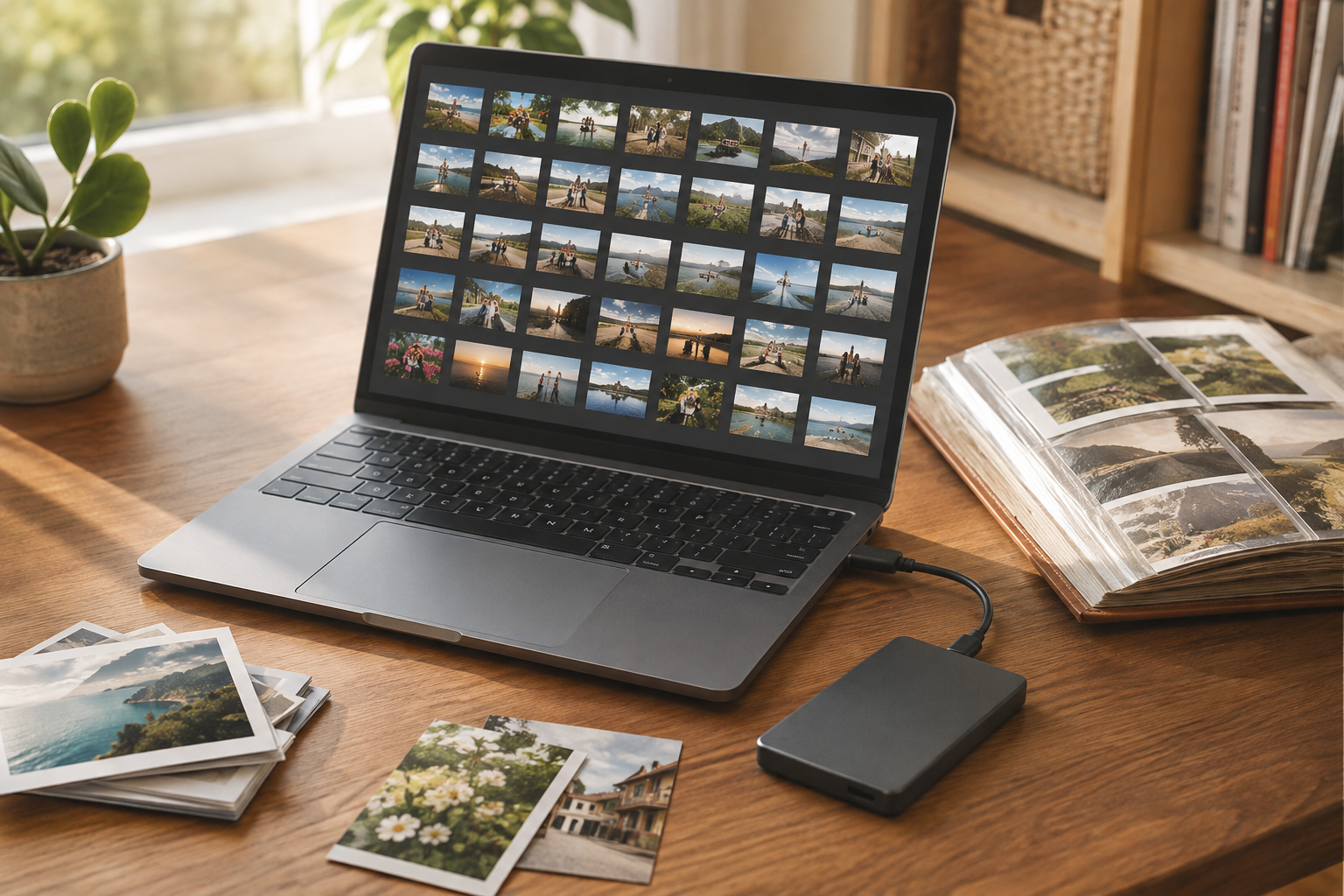
A photo library can look safe because every image appears on a phone and in a cloud application. That view may conceal optimized previews, incomplete synchronization, account dependence, or media stored only inside a proprietary library. The Library of Congress recommends identifying what matters, organizing it, making copies, and checking the collection over time. A durable personal archive follows the same modest logic. It preserves original files and useful metadata, separates backup from synchronization, keeps more than one copy, and tests whether a future person can actually find and open the material without the original phone.
Inventory where the photographs really exist
List every camera, phone, tablet, computer, memory card, messaging application, social platform, and cloud library that may contain originals. For each source, record the account, approximate date range, export method, and whether the visible item is a full-resolution file or a reduced copy. Shared albums and chat attachments often deserve separate attention because they may not enter the primary camera roll. Include scanned photographs and edited exports, but distinguish them from camera originals.
Do not assume synchronization equals backup. A deletion, account error, or corrupted change may propagate across synchronized devices. Some applications conserve local storage by retaining only thumbnails until a file is opened. Use the service’s documented export feature and verify that the result contains expected years, formats, and file sizes. If an export arrives in multiple archives, preserve the package structure until it has been inspected. Keep a migration log with request dates, downloaded parts, and any failures; large libraries often require several attempts, and a log prevents quiet gaps.
Preserve originals and make the structure legible
Retain the original file whenever possible, including its native format and embedded metadata. An edited version may express the intended appearance, so keep that as a derivative rather than replacing the source. Sidecar files can carry captions, ratings, location, or edit instructions; do not discard them merely because a basic viewer does not open them. Avoid bulk conversion until you understand what metadata or image quality the conversion may change.
Create a folder structure based on stable facts such as year and event or subject. A pattern like 2025/2025-11-family-visit remains understandable outside a particular application. Use descriptive filenames only if the process can preserve the relationship between originals, edits, and sidecars. A simple catalog or README can explain people, places, uncertain dates, and naming rules without rewriting every file. Do not encode sensitive personal information in filenames if the archive may be shared. Organization should make retrieval easier while leaving the preserved objects intact.
Keep independent copies in different failure zones
Maintain a working library, a local backup on separate storage, and another copy away from the same room or account. The exact arrangement can vary, but each copy should protect against a different failure. Two folders on one disk are not two backups. Two devices synchronized to one account may still share deletion and account risks. Encrypt storage that could be lost or accessed by others, and keep recovery information separate from the encrypted device.
Copy new material on a schedule that matches how much loss would be acceptable. Disconnect removable backup media when it is not being updated so that malware or accidental commands cannot continuously reach it. An off-site cloud copy needs strong authentication, understood retention behavior, and a way to export without a proprietary viewer. A physical off-site copy needs environmental protection and a refresh plan. No medium is permanent; preservation is a repeated process of copying forward before hardware, accounts, or formats become unusable.
Verify completeness and the ability to restore
Counts alone are useful but insufficient. Compare the number and total size of files by year or source, then inspect samples from the beginning, middle, and end of each export. Open images and videos with ordinary software. Check that dates, orientation, captions, and paired image-video formats survived where those attributes matter. Generate checksums for a stable archive copy so later scans can identify silent changes, but remember that a checksum only compares bytes; it does not prove that the original export was complete.
At least once a year, restore a selected folder from each backup into a temporary location and open the files. Confirm that account credentials and decryption keys still work. Review storage health and replace failing or obsolete devices before they become the only readable copy. Document errors instead of automatically overwriting every copy from the newest one, because the newest copy may contain the damage. Verification turns a reassuring icon into evidence that recovery is possible.
Plan for privacy, access, and succession
A family archive can contain location histories, children, identity documents, medical events, and images that other people did not expect to be public. Decide who may access the archive now, which parts can be shared, and what should happen after the owner can no longer maintain it. Remove public sharing links that are no longer needed. Before giving a drive to another person, review whether hidden albums, deleted-item folders, or application libraries contain sensitive material.
File formats, privacy laws, and service features change, so no one-time workflow guarantees permanent preservation. The practical standard is observable: important sources are inventoried; original files and meaningful metadata are retained; at least two independent backup copies exist; restore tests are recorded; and an authorized future person can understand the structure. A photo archive succeeds when it remains usable beyond the device and account that first displayed it.
REFERENCES
Sources and further reading
External links support verification and further reading; they do not endorse every statement at the destination. Accessed September 2026.