
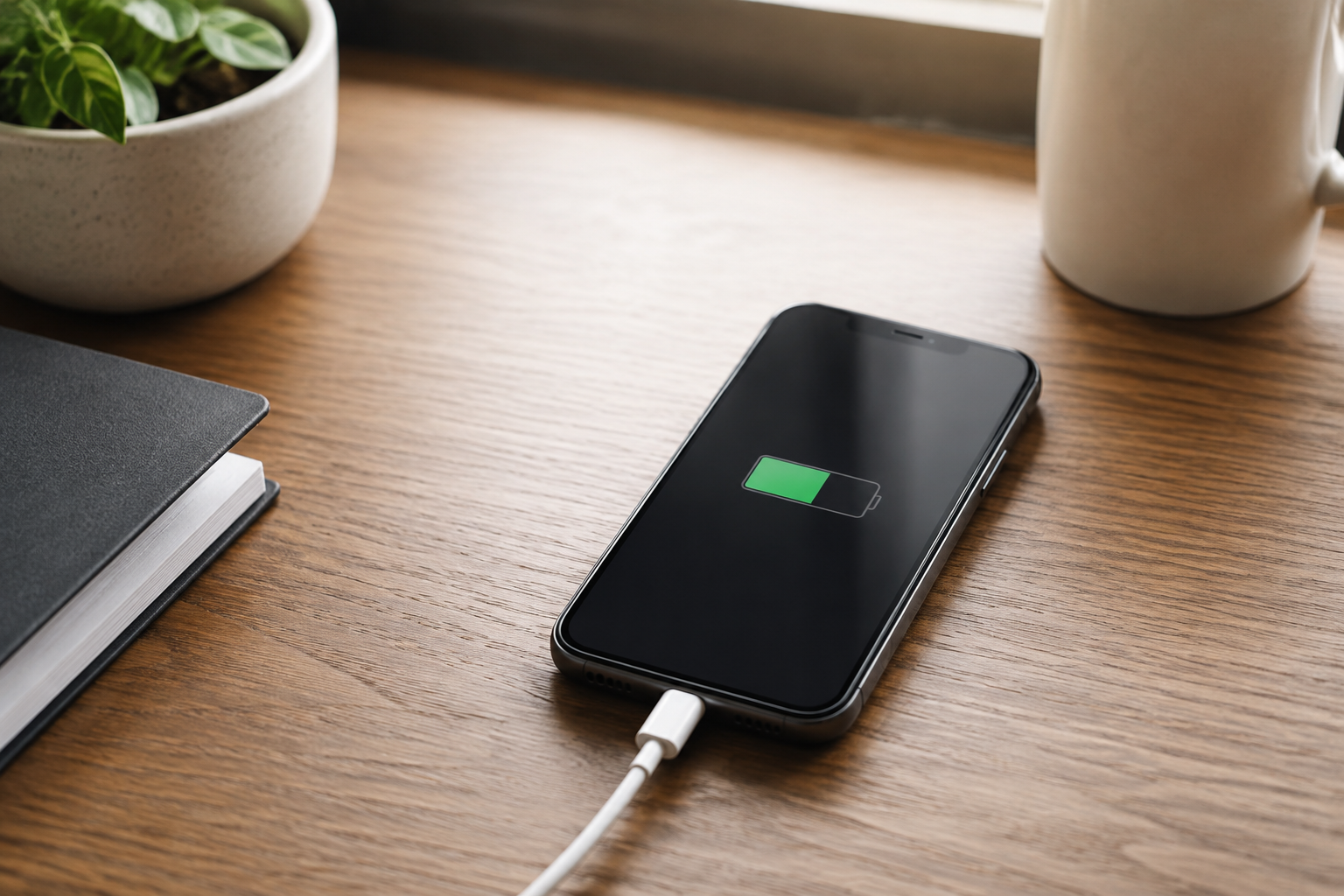
Trying to keep a battery at an exact percentage can turn maintenance into a source of anxiety. Lithium-ion batteries age through time and use. A person can reduce avoidable stress, especially high temperature and long periods at a high state of charge, but cannot stop chemical aging entirely. The practical goal is dependable service over the device’s useful life. That sometimes means charging to full before a long trip, replacing a worn battery, or accepting ordinary decline rather than sacrificing daily usefulness to a perfect-looking health number.
Battery aging has several causes
Capacity decline reflects chemical age, charge cycles, temperature, storage duration, and the states of charge in which a device spends time. A cycle is cumulative; two partial discharges can contribute to a full equivalent cycle. The operating system’s health percentage is an estimate derived from measurement and modeling, not a laboratory verdict. Temperature, calibration, and software updates can produce short-term movement in the displayed value. One percentage-point change does not by itself justify service.
Charging speed also depends on temperature and current battery level. Devices often reduce power near full charge or when internal sensors detect heat. That behavior is protective rather than evidence of a broken charger. The most useful observations are practical: unexpected shutdowns, swelling, unusual heat, a sudden large loss of runtime, or an inability to cover the core task. Those symptoms deserve attention; daily numerical fluctuations usually do not.
Prioritize heat and long-term patterns
High temperature is a controllable source of stress. Playing a demanding game while fast-charging, exporting video under a thick insulating cover, or leaving a device in a sunlit car can raise internal temperature. If the device becomes unusually hot, reduce the workload, remove an obstructive case when safe, move it out of direct sun, and allow airflow. Repeatedly unplugging at an exact percentage while the device remains hot misses the more important variable.
For a laptop connected to power most weekdays, use the manufacturer’s optimized charging or charge-limit feature if available. For a phone with a stable overnight routine, enable the system’s adaptive charging. These controls use battery-management information unavailable to a generic third-party utility. Before travel, charging to full is a reasonable tradeoff. The battery exists to support the day. A longevity practice that makes the device unreliable for its actual role is not a successful practice.
Applied configuration: a docked laptop that travels
For a laptop attached to a monitor and power dock most workdays, enable the operating system or manufacturer battery-protection feature when supported. Raise the device on a stable stand that leaves intake and exhaust vents clear. During a long export, confirm that the computer is not covered by papers or placed against a heat source. A manual plug timer is unnecessary when the supported charge-management feature already performs the intended role.
Before planned travel, disable the limit if full capacity is needed and use the available battery without guilt. At a low frequency, record actual runtime during the same familiar workload and the system’s reported health. A quarterly record is more useful than reacting to small daily estimates because it can reveal a trend. The arrangement balances fixed-desk care with the reason a laptop contains a battery: mobility.
A calm maintenance routine
Check whether the operating system provides optimized, adaptive, or smart charging. Prefer the built-in function and read the manufacturer’s explanation of when it activates. Keep vents clear during charging and heavy use. Do not charge devices under bedding or on soft surfaces that block airflow. Use reputable power accessories that meet the device’s requirements, and replace damaged cables rather than bending them into position.
Review health and real runtime every few months, using roughly the same brightness and workload. When runtime no longer covers the core need, compare battery replacement with device replacement, considering support status, repair cost, and environmental impact. If a battery swells, leaks, smells unusual, becomes extremely hot, or deforms the case, stop using the device and contact qualified service. Do not puncture, compress, mail, or discard a damaged lithium-ion battery with household waste.
Limits and the useful conclusion
Battery-management behavior differs by manufacturer, model, and operating-system version. A third-party limit tool may require deep privileges and may not understand the hardware’s own controls. Cold conditions can temporarily reduce available performance and runtime, while heat is a more important long-term concern. Published advice cannot diagnose a particular damaged pack, and self-repair may create fire, injury, data, and warranty risks.
The conclusion is practical and observable: reducing repeated high heat and avoiding unnecessary months at full charge is more useful than defending one exact percentage every day. Track whether the device still completes its intended work under recorded conditions. Use built-in protection when it fits the routine, charge fully when the day requires it, and replace a consumable battery when its degraded service becomes the real bottleneck. Good maintenance should fade into the background. The device should support the person, not recruit the person as a full-time battery attendant.
REFERENCES
Sources and further reading
External links support verification and further reading; they do not endorse every statement at the destination. Accessed September 2026.