
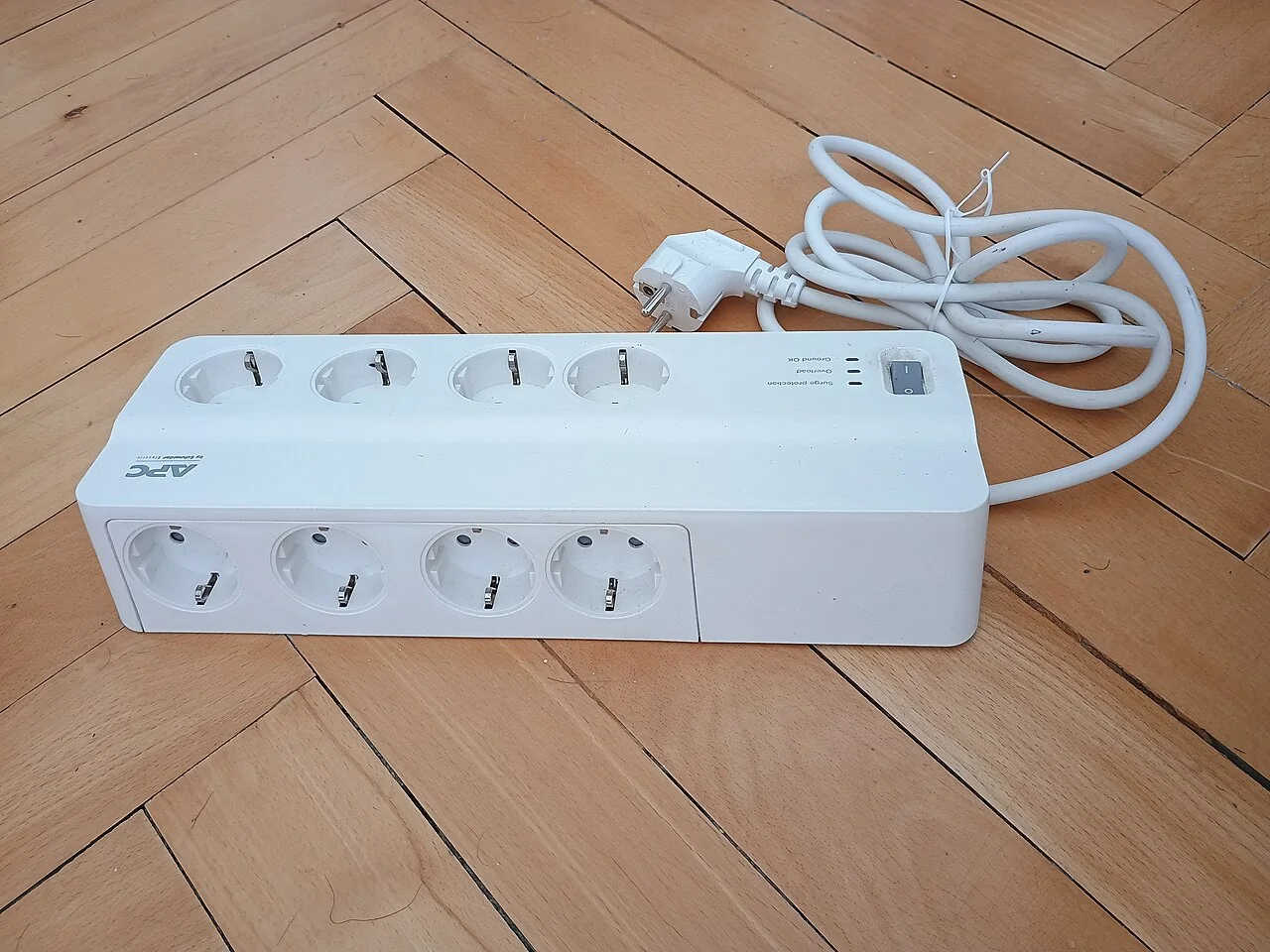
A crowded desk often hides its electrical arrangement. Several chargers disappear behind a monitor, a strip is pushed against furniture, and the unused sockets look like permission to add another device. They are not a measure of available capacity. A power strip distributes a connection; it does not create another household circuit. This guide is a visual inspection and planning aid for ordinary users, not instructions for repairing wiring, opening a strip or testing a suspected live electrical fault.
Start with reasons to stop using the setup
Before adding or rearranging equipment, look for damage that makes the arrangement unsuitable for continued use: frayed insulation, cracked housings, scorched areas, loose plugs, crushed cords or signs of liquid exposure. Unusual heat, burning smells, sparking or repeated protective-device trips require attention rather than a more powerful-looking accessory. Do not handle a suspect live component to investigate it. If there is smoke, fire or an immediate hazard, move away and follow local emergency guidance.
The U.S. Fire Administration advises against overloaded power strips and recommends internal overload protection. It also warns against damaged cords and placing them where they can be pinched. Those recommendations explain why a tidy appearance is insufficient. A cable can be concealed neatly under a rug yet still be poorly placed. A damaged wall outlet or persistent circuit problem needs a qualified electrician, not a new strip to disguise the symptom.
Read the rating for the whole product
Find the manufacturer's identification, model and electrical rating. Consult the instructions for the intended voltage, maximum load and permitted use. If those markings are missing or unreadable, socket count and cable thickness are not reliable substitutes. A listing's advertising headline also cannot tell you whether the actual product in your hand has the same rating.
An illustrative calculation shows the distinction. Suppose three loads were genuinely specified as 60, 90 and 30 watts for the relevant operating condition. Their arithmetic total would be 180 watts. That number is only a subtotal for those fictional loads; it does not establish a safe limit for an unknown strip, wall outlet or circuit. Actual input ratings, startup behavior, simultaneous operation and local requirements still matter. Do not convert a convenient example into a universal rule about how many devices any household may connect.
Separate the strip limit from the circuit limit
Different wall outlets may belong to the same circuit. Moving one plug to a nearby socket therefore does not necessarily give it an independent supply. Likewise, a strip's overload protection and the building's protective devices serve different parts of the installation. Neither should be treated as a reason to deliberately load equipment until something trips.
Write down what shares the arrangement, including devices used only occasionally. A heater brought to the desk in winter can change the picture more than another low-power accessory. The Fire Administration directs major appliances to wall outlets rather than extension cords. Follow each appliance's and strip's instructions; do not infer permission from an adapter fitting. If the required load or existing wiring is uncertain, get qualified advice before extending the setup. An improvised chain of strips is not a substitute for properly located outlets.
Understand what surge protection does not solve
A product described as a surge protector is not automatically suitable for every load or location. Surge protection does not correct loose wall contacts, damaged insulation, an overloaded circuit or a cord trapped under a chair. Overload protection and surge protection address different issues, so check the actual functions and replacement instructions rather than relying on a familiar label.
Look for traceable manufacturer information and safety assessment appropriate to your country. A logo alone cannot rule out counterfeiting or guarantee the state of an aging unit. If a model has a replace indicator, learn what it means in that model's instructions. Do not assume the illuminated power switch verifies that every protective component is functioning. Retire a unit when its documented condition requires it; do not open the casing to attempt an unqualified repair or bypass a failed protective device.
Leave the installation inspectable
Position cords so normal movement does not pinch, stretch or abrade them. Keep the strip away from liquids and from places where papers, fabric or other materials can cover it. Do not run cords through openings or environments for which they are not designed. Follow the mounting instructions rather than driving a fastener through a housing or improvising a support that strains the cable.
Label essential plugs if disconnecting the wrong device would interrupt important work, but keep labels from obscuring safety markings or ventilation. Photographing the overall arrangement can help a future review, provided the picture does not become a replacement for inspecting its actual condition. After moving furniture or adding equipment, check the route again. A previously clear cable can end up under a wheel, and a plug that once fitted properly can become loose through repeated movement or damage.
Make a decision, not a certificate
The outcome of this review should be one of three practical actions: continue with a documented suitable arrangement, remove a damaged or inappropriate component, or ask a qualified person to resolve an uncertain installation. A visual inspection cannot certify the hidden condition of wiring or predict every failure.
Keep the model instructions and a simple equipment list accessible. Recheck after a change in connected loads, damage, unusual operation or a move.
REFERENCES
Sources and further reading
Sources reviewed October 20, 2026. Provider instructions and product terms can change. Examples identified as fictional are editorial illustrations, not reported events or product tests.